Malaysian spices are categorized into dry spices and wet spices. First, dry spices: there are four types. Staranise (bunga lawang), cinnamon or cassia (kulit kayu manis), caedamom (pelaga) and clove (bunga cengkih)
In soups and curries these four kinds of spices always appear without fail. They are normally used whole but some spice manufacturers blend these four spices, together with others in powder form for a convenient mix.
The mixed combinations are labeled accordingly as spices for seafood curry, for meat curry, for making soup or just plain masala. One of the most popular brands for Malay spices is the company Adabi. Other brands popular in Malaysia are Alagappa and Baba's.
Commercially produced cili boh used some chemicals to make it last longer. It makes the paste sour. I recommend you blend your own cili boh using your home blender. It is very simple, cut the dried chilies with scissors, soak in very hot water for about ten minutes, drain the seeds and water. Blend to a fine paste. To make it last longer, add in a bit of cooking oil. Otherwise, a white film will form on the paste that will spoil it, even after refrigeration.
 |
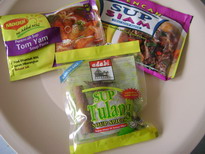
| Spices mix in convenient packs |
For blends of dried spices, each blend is unique and also quite impossible to duplicate. The secret blend will not be revealed outside the family or company.
There is also a combination of whole spices tied up inside a piece of small square muslin (gauze-like cotton) like bouquet garni. This is called "sup bunjut".
Bouquet garni uses fresh western herbs for example in making chicken soup but our "sup bunjut" uses dried spices instead to make chicken soup with Malay spices or the very popular oxtail soup. If you look at the pictures below, you can see that nowadays "sup bunjut" is conveniently packed. Inside the muslin wrapping, exact amount of spices are already measured for specific amount of meat or chicken.
Sup bunjut by Adabi
Together with the four siblings, the following are also used in Malay cooking: turmeric, chili powder, cumin, coriander, mustard seeds, black pepper, anise, fennel, candlenut and fenugreek. The spices mentioned before, are hugely influenced by Indian cooking.
 |
| Dried whole spices: coriander seed, mustard seed and candlenut |


More dried whole spices: anise seed, fenugreek and cumin
Those spices mentioned above are considered as dry spices because they are either processed and dried before usage.
 |
| Fresh green chilies |
Other spices which you will always find in Malay cooking are the wet or fresh spices like fresh chilies, fresh ginger, onion, shallots and garlic. Ginger is normally used for dishes involving meat and chicken. Gelanggal (or lengkuas in Malay language) is also used but only for certain dishes like beef rendang. In fish dishes, turmeric is the spice you can never do without in Malay style of cooking. Powdered turmeric is normally used but fresh turmeric, when it is pounded finely, smells much better in aroma and also looks brighter in color. By the way, turmeric stains on your fingers takes ages to come off. Clever cooks use spoon, or better still, use surgical rubber gloves when they have to handle turmeric.
The Malay spices mentioned above give a lot of character to Malaysian dishes. Cooks use them in large quantities. Subtle flavor is not part of Malay cuisine. Malay food is full, and I mean, really full of flavor. Malay cuisine would never be the same without these spices.




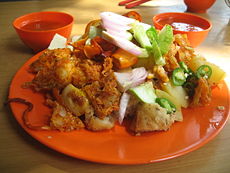
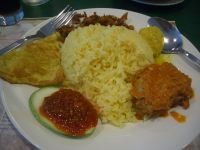


 If you are looking to savour some of Sarawak’s best and favourite eateries, then you’ll have quite a handful to choose from. From Chinese to Malay to Indian – there is always something to suit everyone’s tastebuds. And if you really can’t make up your mind on which place to go to, then why not try heading down to the food court bazaar where you’ll be presented with a wide array of local and international delicacies. Take your pick!
  You’ll be surprised to find that there are actually quite a few good and first-class western restaurants in Sarawak. Serving a variety of western dishes from steaks to salmon and lamb shank – you’ll be spoilt for choice as to which dish to order. You can also choose to have your meal via a la carte style or in buffet fashion.
 Seafood is what Sarawak is famous for. From hawker centre stalls to coffee shop-style outlets to high-class restaurant establishments, you can find seafood at just every corner of Sarawak. Best known for its everyday freshness and cheap pricings, seafood is something that one must try whenever one visits Sarawak. You can’t go wrong with Sarawak’s Seafood!